Talent has never been the scarcest resource in this industry. What's rare is a talented student who shows up consistently, takes feedback well, keeps learning, and builds their presence before they feel "ready."
— Arena Animation Placement Team
India's animation and media industry is growing at over 20% annually. Global studios are outsourcing work to Indian artists. OTT platforms are commissioning Indian content at an unprecedented scale. Game studios are hiring aggressively. The opportunity has never been larger.
Yet walk into any city in India, and you'll find design graduates sitting idle — scrolling job portals, wondering what went wrong. The gap isn't talent. It isn't even the course they took. It's a set of very specific, very avoidable mistakes that play out in predictable patterns, across cities, year after year.
At Arena Animation Dilshad Garden, we've mentored students for nearly three decades. We've watched students from modest backgrounds land jobs at top studios. And we've watched talented students drift away from the field entirely. The difference almost always comes down to the same handful of reasons.
This guide breaks them down — plainly, without filler — and gives you the exact strategies to sidestep every one of them.
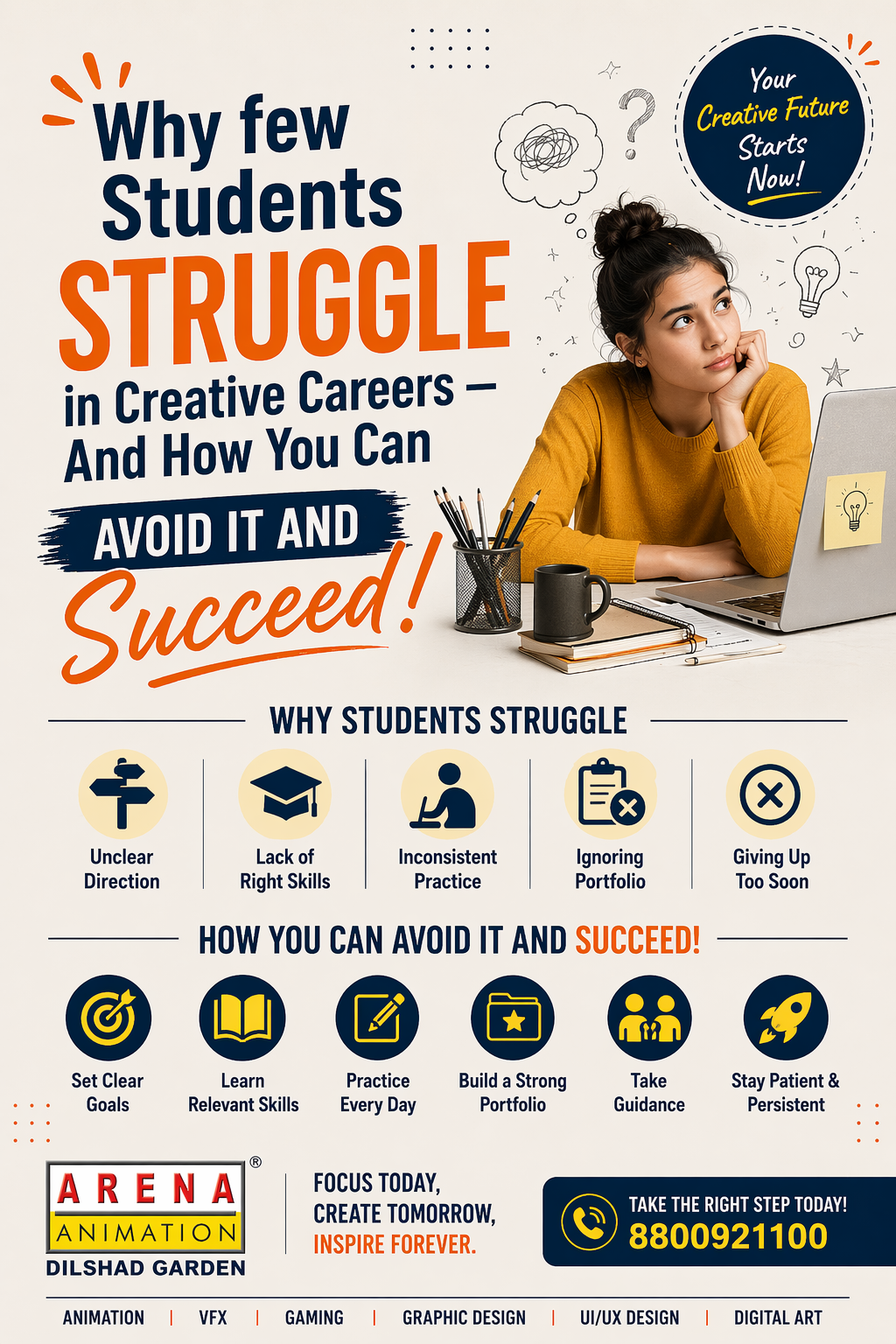
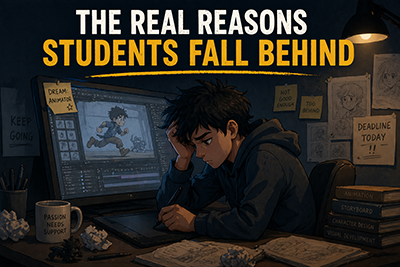
THE 9 REAL REASONS STUDENTS FALL BEHIND
These aren't opinions. These are patterns observed repeatedly — from student conversations, industry feedback, and years of placement data. If even two or three of these apply to you, read carefully.
01
They Learn Software. They Never Learn the Craft.
Knowing After Effects doesn't make you a motion designer. Knowing Maya doesn't make you an animator. There is a critical difference between operating software and understanding the craft it serves — principles of animation, composition, colour theory, storytelling, and visual language.
Most students spend 80% of their time learning where buttons are. They never invest in the foundational principles that make work feel right — the things that separate a showreel that gets watched from one that gets closed in 8 seconds.
FIX: Spend equal time studying great work. Watch award-winning short films. Reverse-engineer what makes them work.
02
Their Portfolio Looks Like a Course Assignment
The single biggest reason freshers don't get calls back. A portfolio should demonstrate what you can do for a studio — not prove you completed your modules. When every project is a textbook exercise, there's nothing that shows creative initiative, personal style, or professional thinking.
Recruiters look at hundreds of portfolios. They search for one thing: evidence you can solve creative problems independently. Generic course outputs do not show this.
FIX: Rebuild at least 3 projects as personal work — something you chose, something with a concept behind it.
03
They Wait for "Course Completion" Before Starting
There is no finish line in creative work. Students who treat their diploma as the start of their career are already behind students who started building their portfolio, experimenting, and taking freelance projects in month three of their course.
The industry doesn't care about your certificate date. It cares about your work date — how long you've been doing real work, not coursework.
FIX: Start building publicly from day one. Post work-in-progress. Share experiments. Fail publicly and fast.
04
Zero Online Presence
In 2026, if you can't be found online, you effectively don't exist as a professional. Studios, freelance clients, and agencies discover talent through Behance, ArtStation, and LinkedIn — not through WhatsApp forwards of your CV.
Many students feel their work "isn't ready" to share. This is a trap. Imperfect work shared publicly is infinitely more valuable than perfect work hidden in a drive folder.
FIX: Create profiles on Behance and ArtStation this week. Upload your three best projects — even if imperfect.
05
They Try to Be Good at Everything
Animation, VFX, motion graphics, UI/UX, 3D modelling, compositing, game design — students often try to learn everything, hoping to maximise options. The result is shallow skills across the board and deep expertise in nothing.
The industry hires specialists. A studio looking for a character animator wants someone who has animated 200 character shots — not someone who has touched animation, texturing, lighting, and rendering at beginner level each.
FIX: Pick one specialisation by the end of your first six months. Go deep, not wide.
06
They Have No Industry Network
The animation industry in India is smaller than it looks. Studios know studios. Artists know artists. A significant proportion of entry-level positions are filled through referrals and connections — not open job listings.
Networking isn't about being clever or political. It's about being present — in communities, at events, in online groups, in comment sections of work you genuinely admire.
FIX: Join animation communities on Discord, LinkedIn groups, and Instagram. Comment on real artists' work — thoughtfully.
07
They Can't Handle Creative Feedback
In studios, your work will be reviewed — constantly, critically, and sometimes bluntly. Students who've grown up hearing only encouraging feedback from friends and family often struggle with professional critique. They take it personally, become defensive, and revise reluctantly.
In a fast-paced studio environment, the ability to receive feedback, implement it quickly, and move on is worth more than raw technical skill.
FIX: Actively seek critical feedback on your work. Ask "what's the weakest part?" — not "do you like it?"
08
They Stop Learning After the Course
Creative industries evolve faster than almost any other field. Tools change. Techniques change. AI is reshaping entire workflows. Students who treat their course as the end of their learning journey become outdated within two years of graduating.
The professionals thriving in animation today are the ones with a self-directed learning habit — always in tutorials, always experimenting with new tools, always testing what's possible.
FIX: Build a 30-minute daily learning habit. YouTube, Skillshare, industry blogs, peer critique. Make it non-negotiable.
08
Ignoring Mock Interviews & Presentations Is a Missed Opportunity.
Avoiding mock interviews and presentations means missing valuable real-world practice.
These experiences help you build confidence, improve communication, and understand how to present yourself professionally.
The more you avoid them, the harder real opportunities become—so start practicing before it truly counts.
FIX: Make it non-negotiable—because consistent practice is what builds real confidence and strong communication skills.
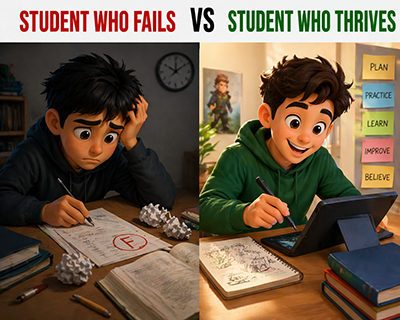
STUDENT WHO FAILS VS STUDENT WHO THRIVES
Here's what the difference looks like in practice — across the habits that actually determine career outcomes:
| Area |
❌ Struggling Student |
✅ Thriving Student |
| Portfolio | Course exercises only | Personal projects with a concept |
| Online presence | No Behance / ArtStation | Active profiles, updated regularly |
| Specialisation | Tries everything, expert in nothing | Clear niche, deep skill |
| Networking | Only talks to classmates | Connected with industry artists |
| Feedback | Avoids criticism | Actively seeks critique |
| Learning habit | Stopped after graduation | Learns daily, tests new tools |
| Mindset | Waiting for the right opportunity | Creating their own opportunities |
THE PLAYBOOK: 8 STEPS TO SUCCEED
These aren't motivational tips. These are specific, actionable steps you can start today — regardless of where you are in your course.
-
1
Audit your portfolio right now. Look at each project and ask: "Does this show creative thinking — or just technical completion?" Delete or redo anything that looks like a textbook exercise.
-
2
Choose your specialisation this week. Talk to working professionals, look at job listings, and pick the one lane where your interest and industry demand overlap most.
-
3
Create your Behance and ArtStation profiles. Post your three strongest pieces. Write a bio that says exactly what you do and what kind of work you want to do.
-
4
Study the 12 Principles of Animation. Even if you're a VFX artist or UI designer. Understanding motion and visual storytelling at a fundamental level will separate your work immediately.
-
5
Speak Better, Perform Better: Presentations & Mock Interviews Matter Clear communication can set you apart.
Presentations and mock interviews help you organize your thoughts, speak with confidence, and handle real-world situations effectively.
The more you practice, the better you perform when it truly matters.
-
6
Create Your Showreel After Every Software Completion. Don’t wait till the end—start building your showreel step by step.
After finishing each software, compile your best work to track your growth and showcase your skills.
This not only builds confidence but also keeps your portfolio industry-ready at every stage.
-
7
Original Work Only: Build a Portfolio That’s Truly Yours Your portfolio is your identity—not a collection of copied work. In a world full of templates and trends, originality is what truly sets you apart.
-
8
Learn one AI tool relevant to your field. Midjourney for concept art, RunwayML for video, Firefly for design. AI is not replacing creative professionals — it's replacing creative professionals who don't understand AI.
A WORD ON TALENT
Talent is not the scarcest resource in this industry. Every city in India has thousands of talented students. What's rare is a talented student who also shows up consistently, takes feedback well, keeps learning, and builds their presence before they feel ready.
The students who succeed aren't the most gifted ones in the class. They're the most disciplined, the most curious, and the most honest with themselves about their gaps. That combination is genuinely rare — and the industry rewards it every single time.
WHY EAST DELHI STUDENTS HAVE A REAL ADVANTAGE
If you're based in East Delhi or nearby areas like Shahdara, Preet Vihar, Vivek Vihar, or Laxmi Nagar — you are closer to opportunity than you might think.
Delhi's media and entertainment industry is significant. Ad agencies, production houses, digital studios, and game companies operate in and around NCR. Noida and Gurugram house multiple VFX studios, gaming companies, and design agencies. Dilshad Garden's metro connectivity gives you direct access to all of them.
Since 2020, remote work is standard across UI/UX and game development globally — Delhi NCR students regularly work with Mumbai, Bangalore, and international clients without relocating. What matters is not geography. It's the quality of your training, the strength of your portfolio, and the mentorship you receive before you enter the market.
That's the foundation our training is built on at Arena Animation Dilshad Garden — and it's why students who come here with the right mindset consistently land roles that students at other institutes with "better" software labs don't. The infrastructure is not the differentiator. The mentorship, the culture, and your own commitment are.
✦
FREQUENTLY ASKED QUESTIONS
-
Why do some animation students fail to get jobs?
Students who struggle usually lack a strong portfolio, skip networking, stop learning after graduation, or never specialise in one discipline. These are fixable habits, not talent problems — and every one of them has a clear, actionable solution.
-
What separates students who succeed in creative careers?
Successful creative professionals build portfolios from day one, seek honest feedback, choose a specialisation early, maintain a daily learning habit, and invest in their online presence before they feel "ready." Discipline consistently outperforms raw talent within three to five years.
-
Is animation a good career in India in 2026?
Yes — strongly so. India's animation and VFX market is growing at over 20% annually. OTT platforms, gaming studios, and global outsourcing create strong, sustained demand for skilled Indian creative professionals. The shortage is not in jobs — it's in job-ready candidates.
-
How important is a portfolio compared to a degree?
In animation, VFX, game design, and UI/UX, your portfolio is significantly more important than your degree. Recruiters evaluate your work first — a certificate only confirms you completed training. It does not prove you can deliver. Portfolio quality is the single biggest factor in placement outcomes.
-
Which creative specialisation has the best job market right now?
In the current market, Motion Graphics (for digital advertising and OTT), VFX Compositing, and UI/UX Design are seeing the highest demand. Game Design is also growing rapidly with India's gaming sector. Choose based on genuine interest — you'll build deeper skill in something you care about, and deep skill is what gets hired.
-
Can students from East Delhi get jobs in major cities?
Yes. Noida and Gurugram — reachable by metro from Dilshad Garden — house multiple VFX studios, gaming companies, and design agencies. Remote work is also standard across UI/UX and game development globally. Location is no longer a barrier. Portfolio quality and training depth are the only variables that matter.
Still Confused? Come In First.
EXPERIENCE ALL FOUR FIELDS HANDS-ON IN ONE FREE SESSION
No commitment. No pressure. Just honest advice and a real taste of what Animation, VFX, Game Design, and UI/UX actually feel like — before you decide.
📍 Opposite Dilshad Garden Metro Station, East Delhi — 110095 | MESC / NSDC Affiliated Since 1996