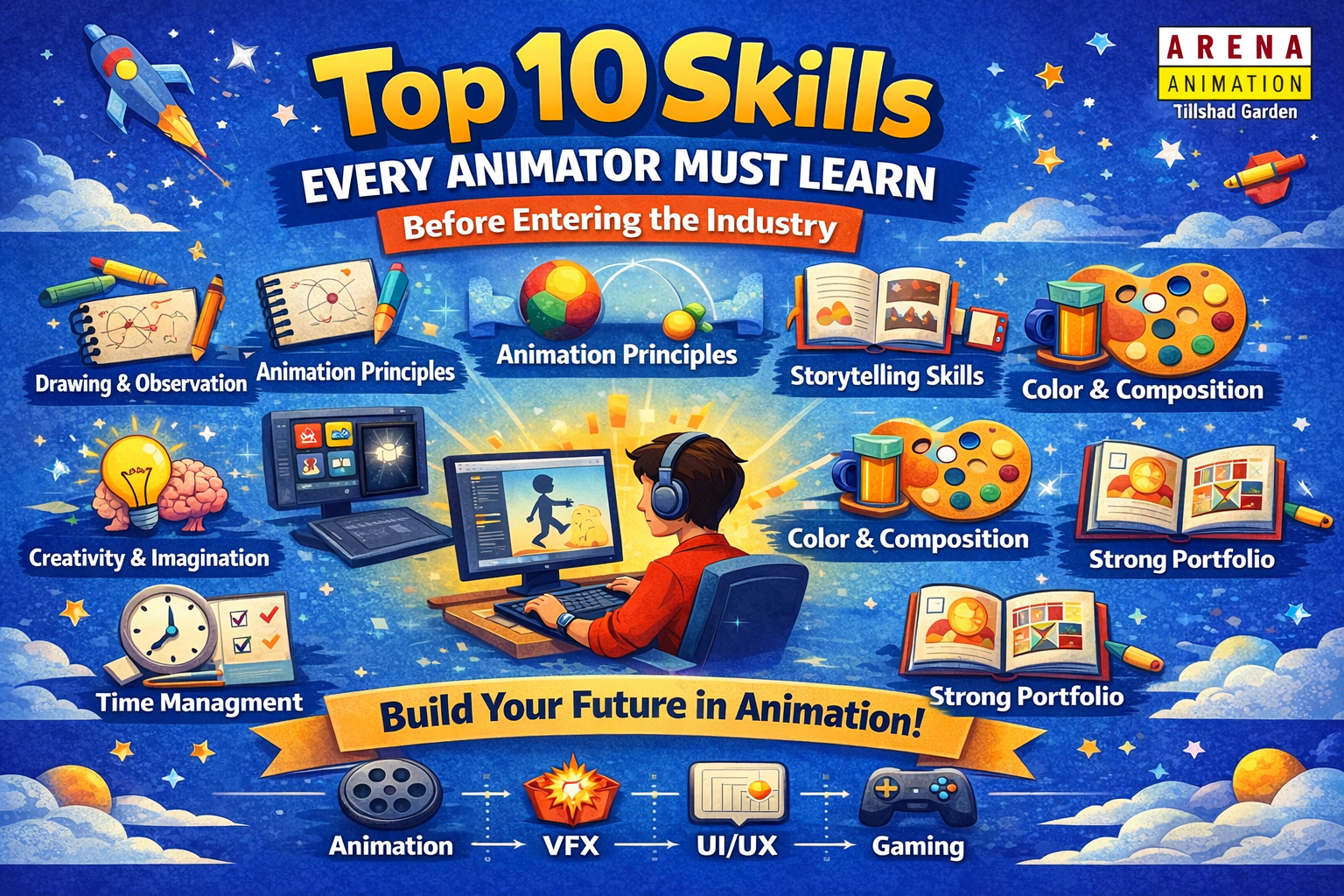
1. Strong Drawing & Observation Skills
Animation begins with observation. Understanding shapes, anatomy, gestures, perspective, and motion helps animators create realistic and expressive characters. Even in 3D or motion graphics, drawing fundamentals form the base.
Strong drawing and observation skills are the backbone of animation, whether you choose 2D animation, 3D animation, VFX, motion graphics, or UI motion design. Animation is not about copying images—it’s about understanding how things move, feel, and react in real life.
Observation is the skill of studying real-life movement and behavior. Great animators closely observe, these observation helps create natural and realistic animation, instead of stiff or robotic movement.
Drawing & Observation teaches animators how to:
- Understand shape, form, proportion, and perspective
- Create believable characters and environments
- Visualize ideas before executing them digitally
- Improve hand–eye coordination and creative confidence
- How objects fall, bounce, stretch, and react to gravity
- Facial expressions, body language, and weight shift
- At our institute, students start with foundation art & visualization training.
👉 At Arena Animation Dilshad Garden, many students start as absolute beginners and gradually build strong fundamentals.
2. Knowledge of Core Animation Principles
Animation principles are the rules that bring life to drawings and digital characters. Without these principles, animation looks mechanical and unrealistic. Mastering them is what separates a beginner from a professional animator.
Principles like squash & stretch, timing, anticipation, follow-through, and exaggeration are the backbone of animation. These principles bring characters and objects to life.
Key Core Animation Principles Every Animator Must Know
- Squash & Stretch: Shows weight, flexibility, and impact in objects and characters, making movements feel natural.
- Timing & Spacing: Controls the speed and rhythm of movement. Good timing makes actions believable and emotionally effective.
- Anticipation: Prepares the audience for an action, making movements clearer and more realistic.
- Follow Through & Overlapping Action: Ensures body parts don’t stop at the same time, creating fluid and natural motion.
- Arcs: Natural movements follow curved paths, not straight lines—essential for realistic animation.
- Exaggeration: Enhances emotions and actions without losing believability, making animation more engaging.
- Staging: Clear presentation of an idea so the audience understands the action instantly.
- Appeal: Makes characters and scenes visually pleasing and emotionally connectable.
👉 At Arena Animation Dilshad Garden, we focus strongly on these principles because they form the core foundation of animation skills. And also ensure students practice these principles through hands-on projects, not just theory.
3. Storytelling & Visual Communication - The Heart of Animation
Good animation always tells a story—whether it’s a short clip, an ad, or a film sequence. Understanding emotion, expressions, pacing, and visual storytelling is crucial. Animation is not just about movement; it’s about communication through visuals. Storytelling and visual communication are what turn animation into an emotional, meaningful experience for the audience. Anyone can learn tools, but not everyone can tell a story. Strong storytelling and visual communication turn technical skills into powerful creative careers.
Key Elements of Storytelling & Visual Communication
- Character Expression : Facial expressions, body language, and posture reveal what a character feels—even without dialogue.
- Visual Flow : The viewer’s eye should naturally move from one element to another through composition and motion.
- Emotion & Mood : Colors, lighting, camera angles, and timing influence the emotional tone of a scene.
- Clarity of Action : Every movement must have a clear purpose so the audience understands what’s happening instantly.
- Pacing & Rhythm : The speed of animation affects storytelling—slow for emotion, fast for energy and excitement.
👉 At Arena Animation Dilshad Garden, we train students to think beyond software and learn how to tell stories visually, just like the industry demands.
4. Color Theory & Composition-The Visual Language of Animation
Colors create mood, depth, and impact. Knowledge of color harmony, lighting, contrast, and composition helps animators create visually appealing scenes. Color and composition are what make animation visually powerful and emotionally effective. Even the best animation can fail if colors are confusing or composition is weak. Mastering these two skills helps animators control mood, focus, and storytelling.
Key Concepts of Color Theory Animators Must Know
- Color Wheel & Color Harmony : FKnowing primary, secondary, and tertiary colors helps create balanced and pleasing visuals.
- Warm vs Cool Colors : ThWarm colors (red, orange, yellow) create energy and excitement, while cool colors (blue, green) create calm and depth.
- Color Psychology : Different colors evoke different emotions—red for intensity, blue for trust, green for balance, etc.
- Contrast & Visibility : Strong contrast ensures characters and actions stand out clearly from the background.
- Lighting & Mood : Lighting combined with color sets the atmosphere—dramatic, happy, mysterious, or sad.
👉 At Arena Animation Dilshad Garden, we train students to use color and composition with purpose—not randomly.
5. Industry-Standard Software Skills
Animation studios expect proficiency in professional tools used across 2D, 3D, VFX, motion graphics, and UI animation.
- 💻 At Arena Animation Dilshad Garden, students train on latest industry-relevant software aligned with studio workflows.
6. Creativity & Problem-Solving
Creativity is not just imagination—it’s the ability to solve visual problems, generate ideas, and adapt concepts as per project needs.
- 🚀 We focus on developing original thinking and concept development in every student.
7. Attention to Detail
Small details—like eye movement, body weight, shadows, transitions, and timing—separate amateurs from professionals.
- 🔍 Our mentors push students to refine work until it meets industry quality standards.
8. Time Management & Professional Discipline
The animation industry works on strict deadlines. Learning how to plan shots, manage time, and deliver projects on schedule is essential.
- ⏱️ Our training simulates real studio environments to build professional discipline.
9. Teamwork & Communication Skills
Animation is a collaborative process involving designers, animators, editors, developers, and clients.Clear communication saves time and improves output.
- 🤝 Group projects and reviews at our institute help students learn team collaboration.
10. Strong Portfolio Development
Your portfolio is your identity in the animation industry. Studios hire based on skills shown in your work, not degrees alone.
- 📁 We guide students step-by-step to create a job-ready portfolio that attracts studios and clients.
Why Learn These Skills at Arena Animation Dilshad Garden?
- Industry-oriented curriculum
- Experienced mentors
- Practical & project-based learning
- Portfolio & placement assistance
- Career guidance for animation, VFX, UI/UX & design
The animation industry rewards skill, creativity, and consistency. Mastering these 10 skills before entering the industry gives you a powerful head start toward a successful creative career.
Visit 📍 Visit Arena Animation Dilshad Garden and start building your future in animation with the right guidance.