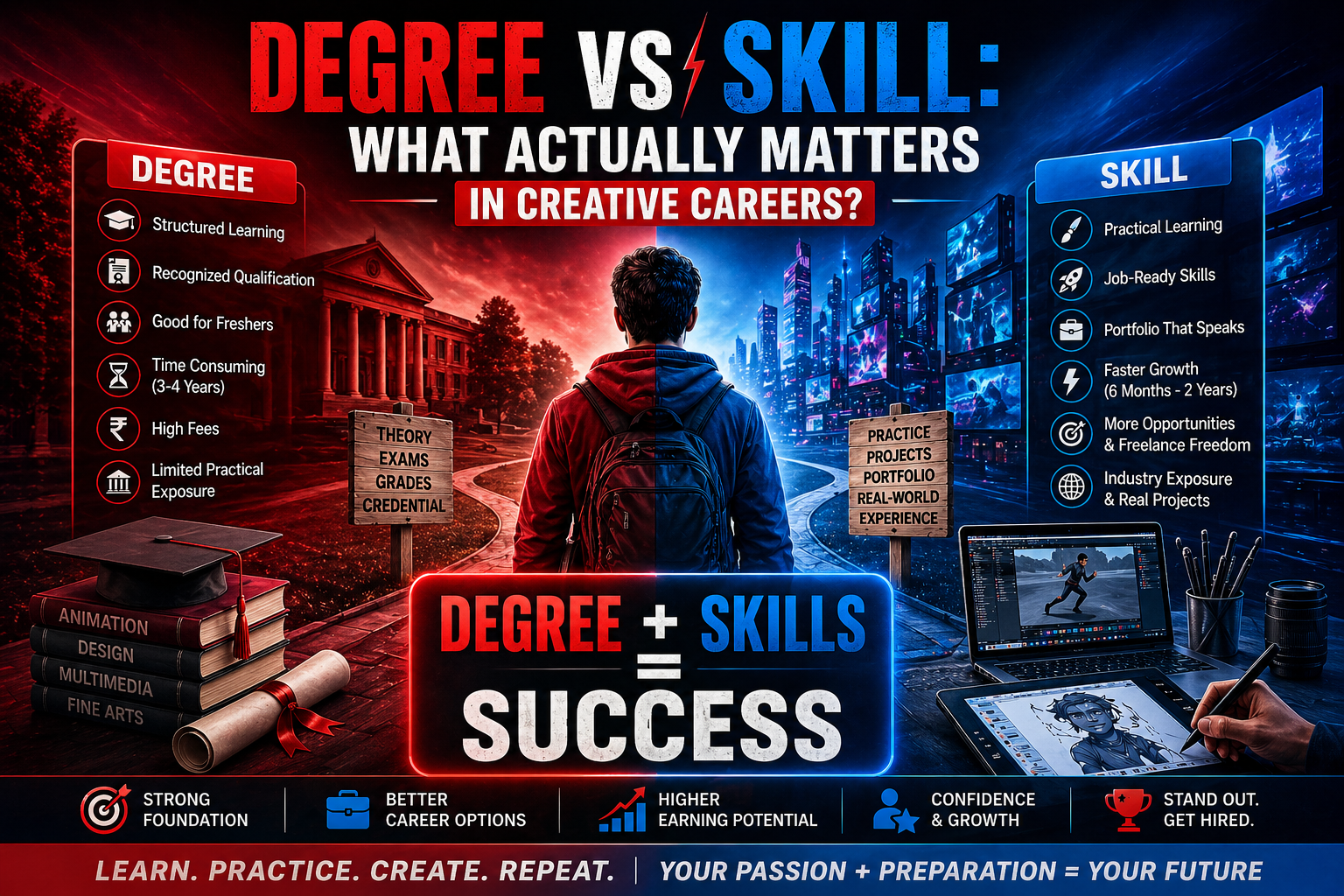
DEGREE VS SKILL:
WHAT ACTUALLY MATTERS
IN CREATIVE CAREERS?
Studios don't frame your degree on their wall. They play your showreel. In the creative industry, your portfolio has always been your real certificate — and it always will be. — Arena Animation Placement Team
Every year, thousands of students walk into animation, VFX, game design and UI/UX institutes across India carrying the same question their parents have been asking: "But will you get a degree?" And every year, hundreds of talented graduates with spotless certificates walk out of those institutes — and into a prolonged, frustrating job search.
Meanwhile, across the city, someone who spent the last 18 months building obsessively, uploading work publicly, and taking brutal feedback gets a studio call within weeks of completing their course.
So what actually matters? Is a degree worthless? Is skill everything? Or is the real answer more nuanced than the internet would have you believe?
At Arena Animation Dilshad Garden, we've placed students in studios for nearly three decades. We've seen every version of this debate play out in real time — not in theory, not on Reddit threads, but in actual placement outcomes, studio feedback, and career trajectories. Here is what we know.
The Core Question
WHAT DO STUDIOS ACTUALLY LOOK AT FIRST?
Walk into any animation or VFX studio in India and ask the hiring manager: "What's the first thing you look at when a fresher applies?" The answer — almost universally — is: the portfolio or showreel.
Not the certificate. Not the college name. The work.
This isn't unique to animation. It's true across UI/UX design, game development, motion graphics and digital marketing. Creative industries have always operated on a show-don't-tell basis. A portfolio is a direct demonstration of what you can do. A degree is evidence that you once completed a structured programme. These are two fundamentally different things — and studios care about the former.
This doesn't mean degrees are worthless. It means understanding what each one actually does — and building your career strategy accordingly.
WHAT A DEGREE GIVES YOU — AND WHAT IT DOESN'T
✓ What a Degree Gives You
- Formal credential for government and PSU roles
- Eligibility for higher education (M.Des, MBA)
- Required for some visa and immigration processes
- Structured learning framework over 2–3 years
- Widens eligibility for corporate HR filters
- Adds credibility in client-facing freelance roles
- Provides student identity and institutional backing
✗ What a Degree Does NOT Give You
- Studio job offers — showreels do that
- Portfolio — that requires personal initiative
- Industry network — that requires showing up
- Specialised craft skill — that requires repetition
- Freelance clients — that requires online presence
- Creative problem-solving — that requires projects
- Placement guarantee — nothing does that
The mistake most students make is assuming that completing a degree means they are career-ready. A degree marks the end of structured learning. Career readiness is built in parallel — through personal projects, online presence, real feedback, and genuine creative output.
What Skill Actually Means
SKILL IS NOT THE SAME AS SOFTWARE KNOWLEDGE
Here is where most conversations about skill go wrong. Students hear "build your skills" and immediately start a new course — a new software, a new plugin, a new tool. But skill in a creative context is not the same as knowing how to operate software.
Software knowledge = knowing where the buttons are.
Creative skill = knowing what to do with them — and why.
A character animator who has animated 300 shots has skill. A student who completed the Maya module has software familiarity. These are not equivalent, and studios can tell the difference in the first 15 seconds of watching your showreel.
Real skill — the kind that studios hire for — is built through:
- ✓Completing personal projects with a creative brief behind them — not just following tutorials
- ✓Receiving and implementing professional critique — repeatedly, over months
- ✓Studying great work in your field and understanding why it works
- ✓Failing publicly, iterating, and shipping imperfect work anyway
- ✓Going deep in one specialisation rather than staying shallow across five
- ✓Maintaining a daily learning habit long after your course ends
None of these are taught in any formal programme. They are habits — and they separate the artists who thrive from the graduates who drift.
The Real Comparison
DEGREE HOLDER VS SKILL BUILDER: WHAT THE DATA SHOWS

Based on nearly three decades of placement data at Arena Animation Dilshad Garden, here is how outcomes differ between students who prioritise credentials and those who prioritise craft:
| Area | ❌ Degree-First Student | ✅ Skill-First Student |
|---|---|---|
| Portfolio | Course assignments only — no personal work | 3–5 personal projects with original concepts |
| Time to first job | 6–18 months after graduation | 1–4 months after course completion |
| Online presence | No Behance, no ArtStation, no LinkedIn | Active profiles, updated publicly |
| Specialisation | Generalist — tries everything | Clear niche, demonstrable depth |
| Studio feedback | Work looks like a student exercise | Work shows creative thinking and initiative |
| Freelance income | Rarely starts freelancing before placement | Often earns before course ends |
| Long-term trajectory | Stagnates at entry level for 2–3 years | Grows faster due to stronger foundation |
| Response to feedback | Defensive — avoids critique | Seeks brutal feedback, implements fast |
The pattern is consistent. Students who treat their course as an opportunity to build real work — not just complete modules — exit training significantly more employable than students who focus on completion milestones.
When It Gets More Complex
WHEN DOES A DEGREE ACTUALLY MATTER?
It would be dishonest to say a degree never matters. Context determines everything. Here are the specific situations where a formal degree genuinely changes your options:
The Best Answer
THE HONEST VERDICT: SKILL + DEGREE IS THE POWER COMBINATION
The Formula That Wins
A strong portfolio signals to studios that you can do the work. A degree signals to institutions, governments, and clients that you have structured training behind you. Together, they eliminate every barrier — studio hiring, corporate filters, government eligibility, international mobility, and higher education. Separately, each has significant blind spots. Build both. Sequence them deliberately.
The false choice the internet presents is degree or skill. The correct answer is skill-first, degree as a strategic asset.
Here is what that looks like in practice:
- ✓Start building your portfolio from day one of your course — don't wait for completion to begin creating personal work
- ✓Choose a specialisation within the first three months — depth beats breadth at every level of hiring
- ✓Pursue a degree programme that runs alongside skill-building — not instead of it. Arena Animation's B.VOC with Jagannath University is designed for exactly this
- ✓Post work publicly before you feel ready — imperfect work shared builds presence; perfect work hidden builds nothing
- ✓Seek professional feedback consistently — classmates are not your target audience
- ✓Study great work in your field with analytical intent — not just admiration
- ✓Build an online presence on Behance, ArtStation and LinkedIn — studios find talent here, not through job portal applications alone
The B.VOC Advantage
WHY ARENA ANIMATION'S DEGREE PROGRAM IS BUILT DIFFERENTLY
Most degree programmes in India are built around academic milestones: semesters, examinations, credit hours, attendance. Most skill-based institutes are built around software training: complete the modules, get the certificate.
Arena Animation Dilshad Garden's B.VOC programme — offered in collaboration with Jagannath University — is built around a different question: What does it take to actually get hired and succeed in a creative career?
The programme combines a nationally recognised B.VOC degree with hands-on, industry-facing training in Animation, VFX Filmmaking, and Game Design & Development. Students graduate with both a university credential and a production-quality portfolio — which is the combination that eliminates every barrier outlined above.
The curriculum is structured around real deliverables — showreels, portfolio projects, live briefs — not just academic exercises. Industry mentorship, placement assistance, and ongoing career support are built into the programme from admission to placement.
This is what "skill + degree" looks like when it's designed deliberately — not assembled accidentally after the fact.
Common Questions
